
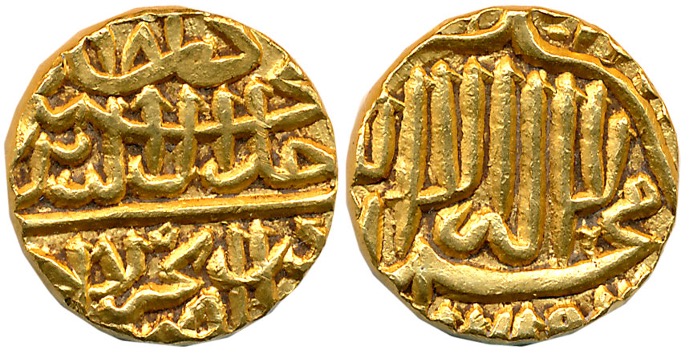
Akbar, Gold Mohur, 10.97g, Nahrwala (Patan) Mint, AH 981, Obv: The Emperor's full name with mint name “Dar al-Zarb Naharwala” (possibly followed by Patan). Rev: The Shahada in a mihrabi cartouche (Not listed in KM or other source on Mughal coinage). Extremely fine+, exceedingly rare, unique.
This coin marks a historic moment in Akbar’s conquest of Gujarat which lasted nearly a year, from July 1672 to May 1673. The court of the Gujarat Sultanate was mired in internal squabbles between various nobles (“Mirzas”) who had gained control of different areas of the kingdom. The opportunity to conquer Gujarat was offered to Akbar in 1672, when Itimad Khan, one of the squabbling nobles, invited him to take over. Gujarat would be a wealthy province with trade access to the seas through its major ports like Khambayat, Surat and Bharuch. Akbar responded to the call and arrived in Gujarat from Fatehpur via Ajmer, Nagore and Sirohi. He reached Ahmadabad, the capital, via Disa and Patan. It was at the time being besieged by Sher Khan and Musa Khan Fuladi, the brothers who controlled the area around Patan. Having heard of Akbar's arrival, Sher Khan Fuladi hurriedly lifted the siege and fled to Saurashtra.
Akbar conquered Ahmadabad in November 1672 (AH980), continuing to take over other parts of East and South Gujarat over the next few months, clearing various quarrelling nobles. In early 1673, he appointed his milk-brother Mirza Aziz Koka as the first viceroy of the province and reorganized the administration. The ex-Sultan Muzaffar III was compensated handsomely. Akbar then departed towards Fatehpur.
However just as Akbar left the province, Muhammad Khan the son of Sher Khan Fuladi captured the area around Patan once again, besieging the imperial governor, Sayad Áhmed Khán Bárha, in the citadel. At this time Mírza Muhammad Husain was at Ránpur near Dhandhúka. When Sher Khán Fauládi, who had taken refuge in Saurashtra, heard of Muhammad Khán’s return to Pátan, he met Mírza Muhammad Husain, and uniting their forces they joined Muhammad Khán at Pátan.
The viceroy Mírza Âzíz Koka with other nobles marched against them, and after a hard-fought battle, in which several of the imperial nobles were slain, Mírza Âzíz Koka was victorious. Sher Khán again fled to Saurashtra, and his son fled for safety to the Ídar hills, while the Mírza withdrew to the Khándesh frontier. As the conquest of Gujarat was completed, Akbar returned to Fatehpur.
This coin very likely marks the victory of Aziz Koka against the Fuladi rebels, and the recapture of Patan, as it is dated AH981 which began in May 1673. Its execution is exactly the same as Akbar's earliest issues from Ahmadabad mint, dated 980 and 981 and in all likelihood the dies used to strike the coin were produced in the same atelier as the Ahmadabad issues. It is peculiar that the H in Naharwala is ‘He’ instead of the usual H, however, since the name itself is a bit unusual to articulate in Farsi, this appears to be an oversight that can be ignored. Silver and very rare gold coins were issued from Patan with mint names ‘Shahr Naharwala’ and ‘Shahr Patan’ a few years later (984 and 985).
Accession No
Weight
Diameter
Metal
Mint
Denomination
Shape