
This remarkable folio leaf comes from the third known manuscript of the historical three-volume Akbar Nama (Book of Akbar), commissioned by the third Mughal Emperor Akbar and written by the court historian and biographer Abu'l-Fazl ibn Mubarak in the late 16th century. The third manuscript is thought to have belonged to Akbar’s mother, Hamida Banu Begum and, according to the renowned scholar Linda York Leach, was probably painted after Akbar’s own series, between 1595 and 1600.
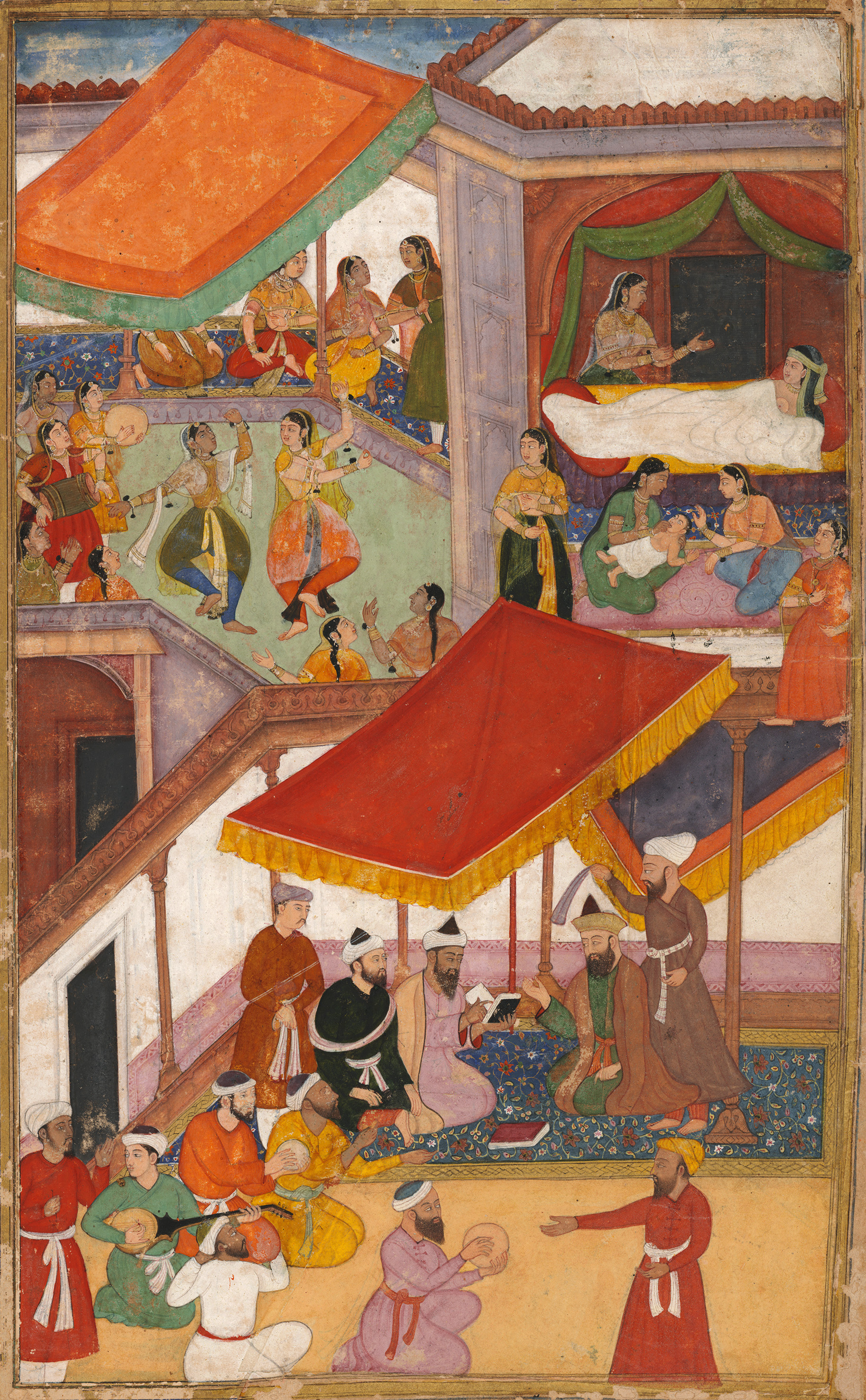
The leaf, which illustrates in remarkable chromatic the birth of Akbar (Abu'l-Fath Jalal-ud-din Muhammad Akbar), in effect comes from the first volume of Akbarnama, which deals with the birth of Akbar (in 1542 A.D.) and his upbringing; the history of Timur's family; and the reigns of Babur and Humayun and the Suri sultans of Delhi. Volume one of Akbarnama encompasses Akbar's birth and his upbringings.
In the lower register of the painting, we observe Humayun, the second Mughal emperor and Akbar’s father, sitting on a splendid carpet of floral design and in consultation with attendants and religious advisers, one of whom reads from a holy book, as they welcome and celebrate the birth of Akbar. Humayun and his retinue are shown kneeling and sitting under a flowing awning and are dressed in traditional Mughal headwear and robes of sober chromatic. Outside the designated area of privileged access to the emperor, musicians are conducted as they play hand drums and a chordophone.
On the upper register of the painting, a remarkable series of vignettes depict the aftermath of Akbar’s birth: in the upper right, Akbar’s mother, Maryam Makani, is seen resting under a flowing white bedspread and being looked after by an attendant following the birth. Although she still wears a traditional head covering, she is shown in a natural state of undress following childbirth. Just below her private chamber, several nursemaids caress and look after the new emperor, shown swathed in a small white robe. To the left of this tableau, a group of women rejoice as they play musical instruments and dance in celebration at this momentous occasion while a group of women outside their quadrant share the welcome announcement.
The architecture of the painting is outstanding as various physical and emotional spaces are defined through geometry and chromatic variation; the cumulative effect of the human interaction is uplifting and greatly expressive of the most significant event in Mughal culture, the birth of the great emperor Akbar.
This page is one of more than twenty miniatures that have recently come to light from an important royal manuscript thought to have belonged to Akbar’s mother, Hamida Banu Begum. Scholars who have studied these paintings, in particular Leach, have identified the manuscript as a third royal Akbarnama.
According to Leach in her study, “Pages from an Akbarnama”1, the newly discovered third Akbarnama pages are related to the Victoria and Albert Museum’s highly coloured, dynamic illustrations and were probably painted after Akbar’s own series, between 1595 and 1600. Stylistically, this manuscript is closer to the first Akbarnama than the later one. Leach convincingly suggests several reasons for identifying the royal family member for whom this Akbarnama was commissioned as Hamida Banu Begum, Akbar’s mother.
Other notable differences in the ‘third’ Akbarnama, further according to Leach, are that the text is written in the conservative naskh script as opposed to the nasta‘liq used on the other two copies (Naskh is a script that Hamida is thought to have preferred); and it features a number of scenes centring on women and their activities, depicting them with unusual animation and intimacy, and showing scenes from the zenana that would have appealed to Hamida. Thirdly, several paintings such as the one above depict her husband Humayun in the context of much greater warmth, tenderness, and drama than his portrayals in the other Akbarnamas.
In the lower margin, in the centre, can be seen an inscription in Persian in black naskh script.
Accession No
Dimensions
Date
Medium