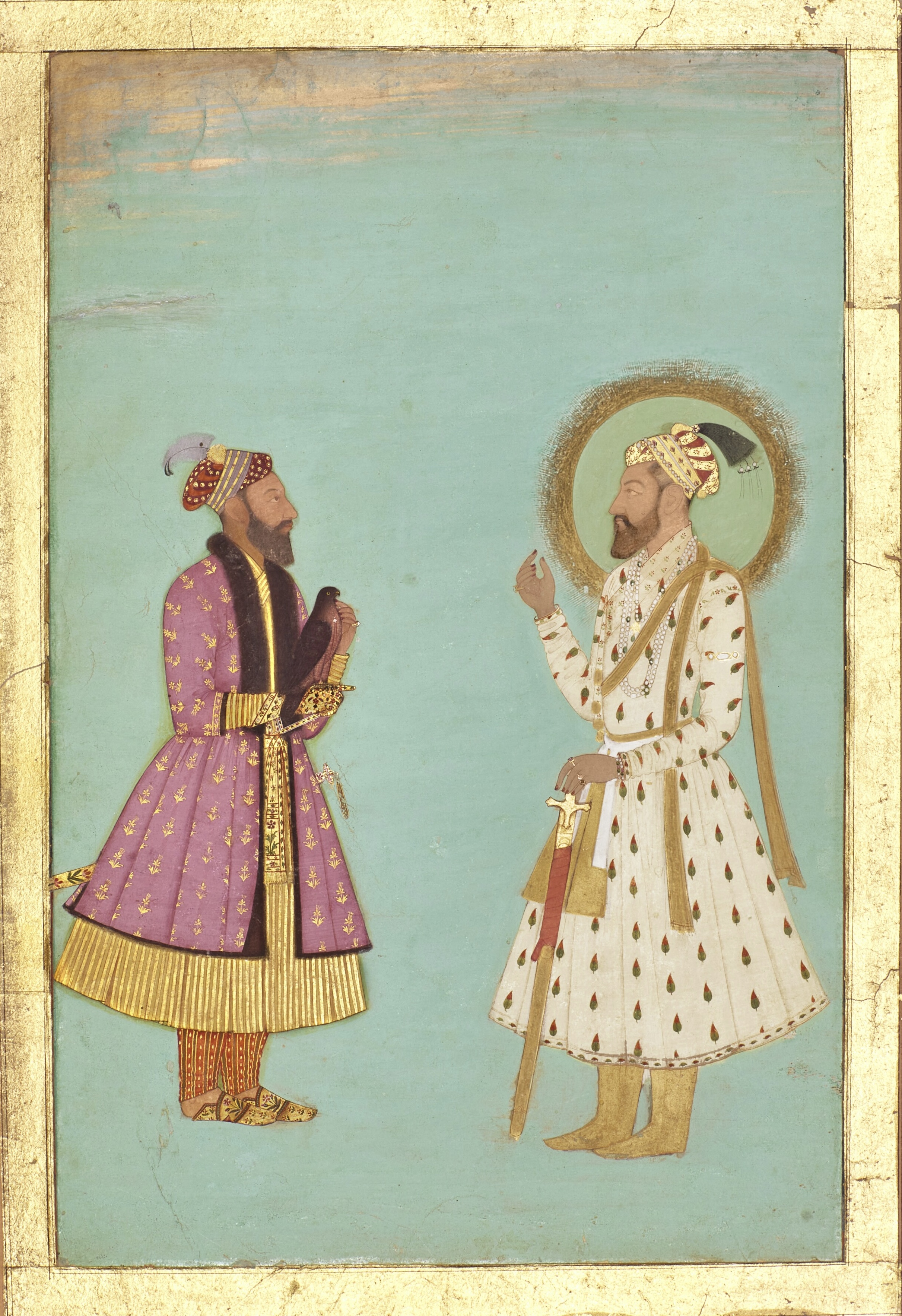
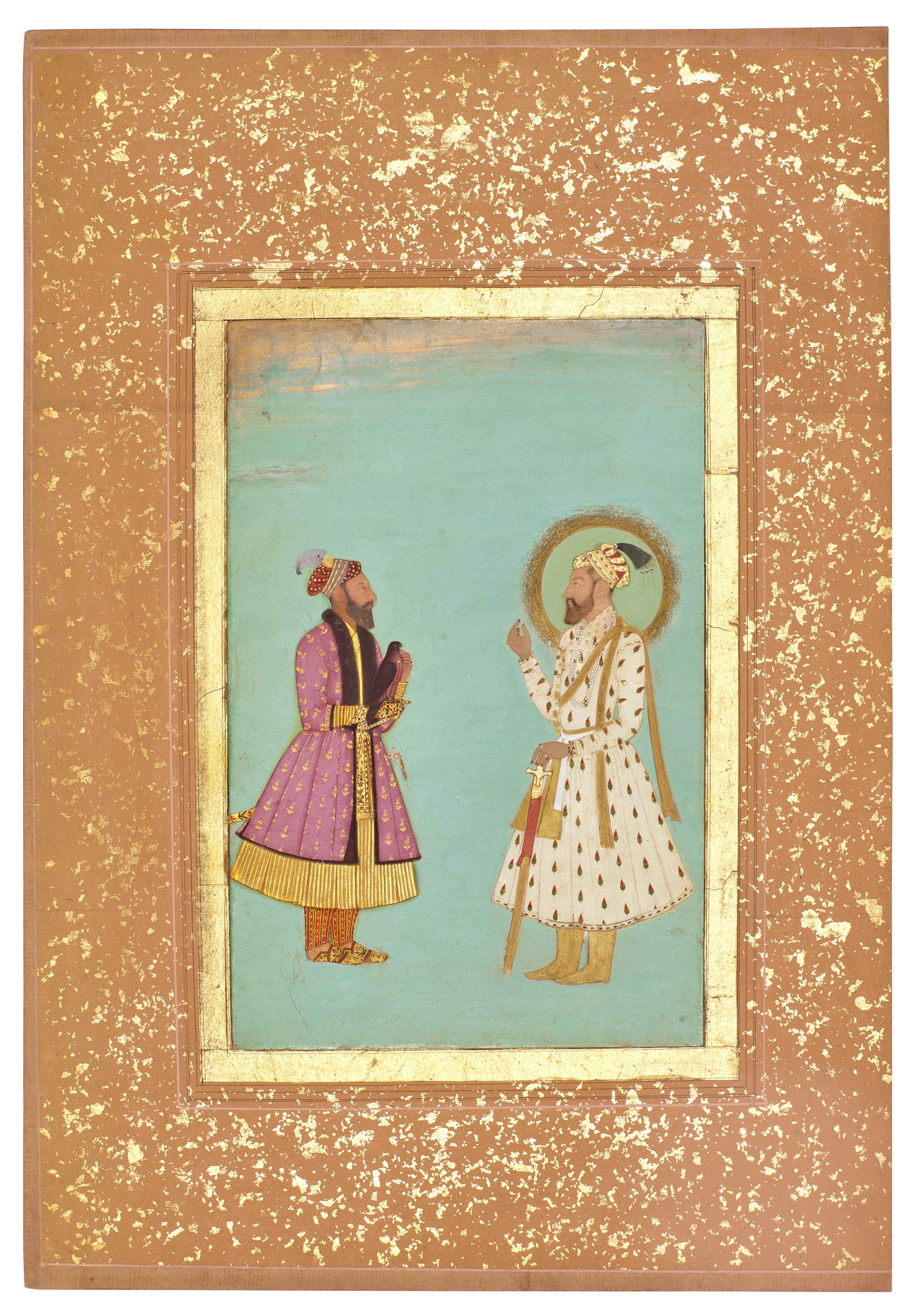
The nimbate ruler stands on the right with his right hand raised and his left resting on a sword. He wears a striped turban decorated with an aigrette, multiple strings of pearls around his neck and a white jama with foliate motifs. A nobleman in a fur-lined purple jama stands before him with a falcon perched on his right hand which is protected by a gauntlet.
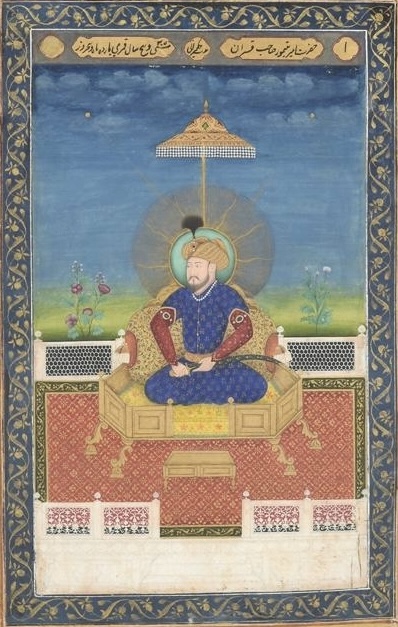
The ruler has been identified as Aurangzeb (r.1658-1707), the sixth Mughal Emperor, better known by his regnal name Alamgir I. A painting depicting the Darbar of Alamgir, attributed to Bichitr and dated to circa 1658, includes a comparable likeness of Aurangzeb soon after he imprisoned his father and assumed the throne (see S.C. Welch, Imperial Mughal Painting, New York 1978, pl.37). A further comparable standing portrait of Aurangzeb, standing in profile, facing right, with his right hand raised and his left resting on a sword, is in the Metropolitan Museum of Art, New York (acc. no.45.174.28).
Aurangzeb stands opposite a young prince who has previously been identified as Prince Mu’azzam Bahadur Shah, the second son of Aurangzeb, but is likely to be his younger brother, Prince A’zam Shah (1653-1707). He was the third son of Aurangzeb and the seventh Mughal emperor, on the throne very briefly from 14 March – 20 June 1707. A durbar scene with four sons and two grandsons of Shah Jahan, by Bhavanidas, dated circa 1700-15, depicts Aurangzeb and Bahadur Shah seated at the lower right, and A’zam Shah at the lower left. A’zam Shah is depicted as a young man here, with very little facial hair (see N. Haidar, ‘Bhavanidas’ in Beach, Fischer, Goswamy (ed.), Masters of Indian Painting, 1650-1900, Vol.II, Zurich, 2011, p.532, no.2, illus. on p.535, fig.2. An equestrian portrait of the prince, dated to circa 1690, in the David Collection in Copenhagen (inv. no. 4/1980), depicts him with a full beard, closer in age to the present painting.
Accession No
Provenance
Dimensions
Date
Medium
Inscriptions