

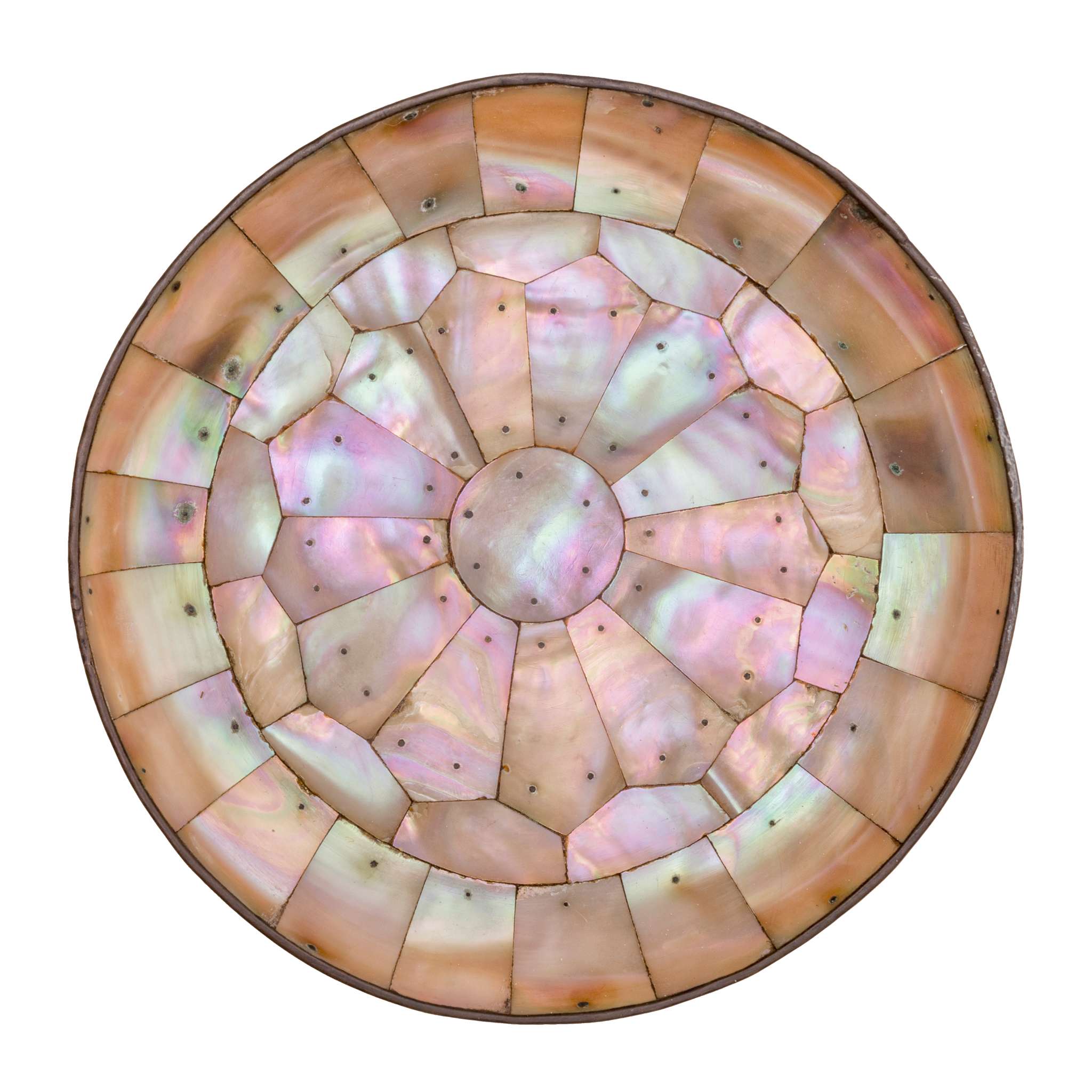
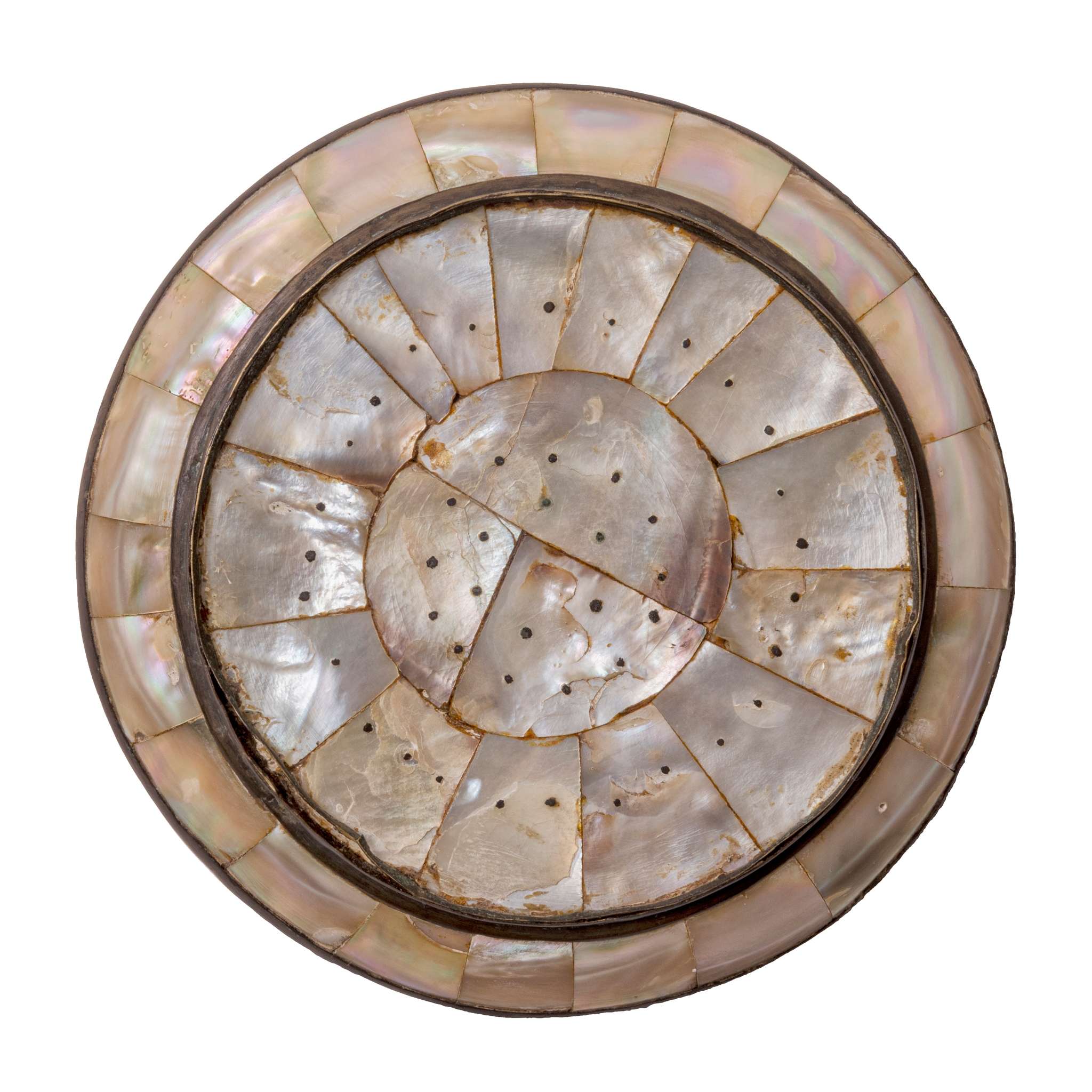
Mother of Pearl craftsmen were working in Gujarat at least from the early 16th century. The Portuguese particularly favoured this type of work and employed Indian craftsmen to produce items for export both for their churches and homes. The earliest items of mother-of-pearl were imported to Europe in the 16th century, including a casket in the Dresden Green vault that entered the collection c. 1525-50. The Bargello Shield entered the Medici armoury in 1599. Items such as the ewer in Peabody Essex Museum, c. 1570-1600, reveal the European style of some objects. Most of the surviving objects are in European collections. Sir John Clerk of Penicuik near Edinburgh is documented as purchasing mother-of-pearl in Paris in the 1640s, the collection from which this piece comes.
The major centres of production of mother-of pearl were Cambay, Surat and Ahmedabad, making the mother-of-pearl work an important regional craft in the Mughal Empire
Description
of shallow form with rounded sides on a short brass ring foot, composed of geometric sections of mother-of-pearl forming a central flowerhead, radiating panels around the sides, all sections pinned, verso with radiating panels, brass band around the rim
Penicuik House
Penicuik Estate, situated to the south-west of Edinburgh at the foot of the Pentlands, has been owned by the Clerk family since the middle of the 17th century. In 1654 the merchant John Clerk (1611-1674), who had made his fortune in Paris, purchased the Estate with the existing house Newbiggin from the heirs of Margaret Scott, the Countess of Eglinton. In 1647 John Clerk married Mary Gray, fourth daughter of Sir William Gray of Pittendrum by whom he had five sons and five daughters. He married for a second time in 1670 to Elizabeth Johnston, and upon his death he was succeeded by his eldest son, John Clerk, who became the 1st Baronet in 1679.
Accession No
Attribution
Date
Size


