
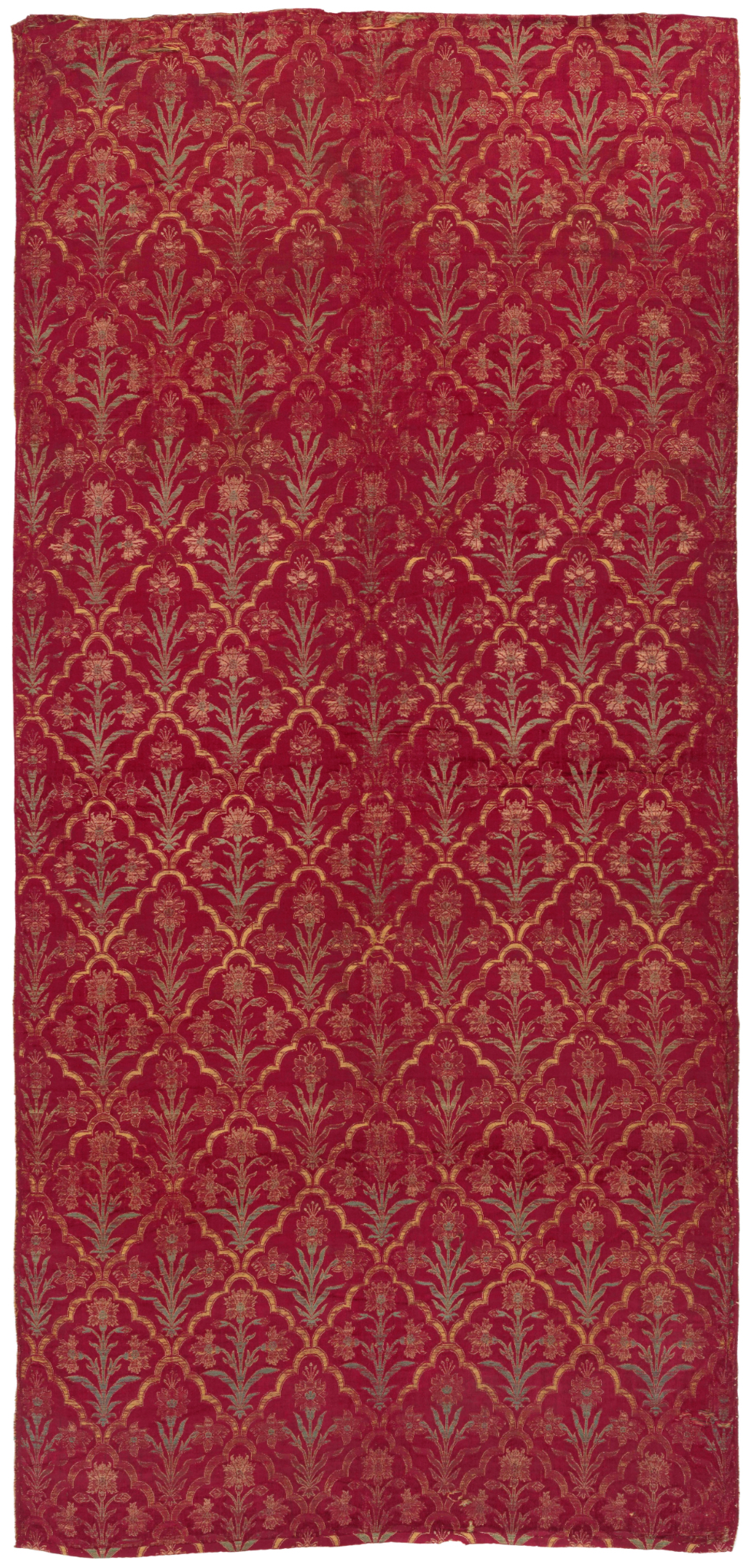
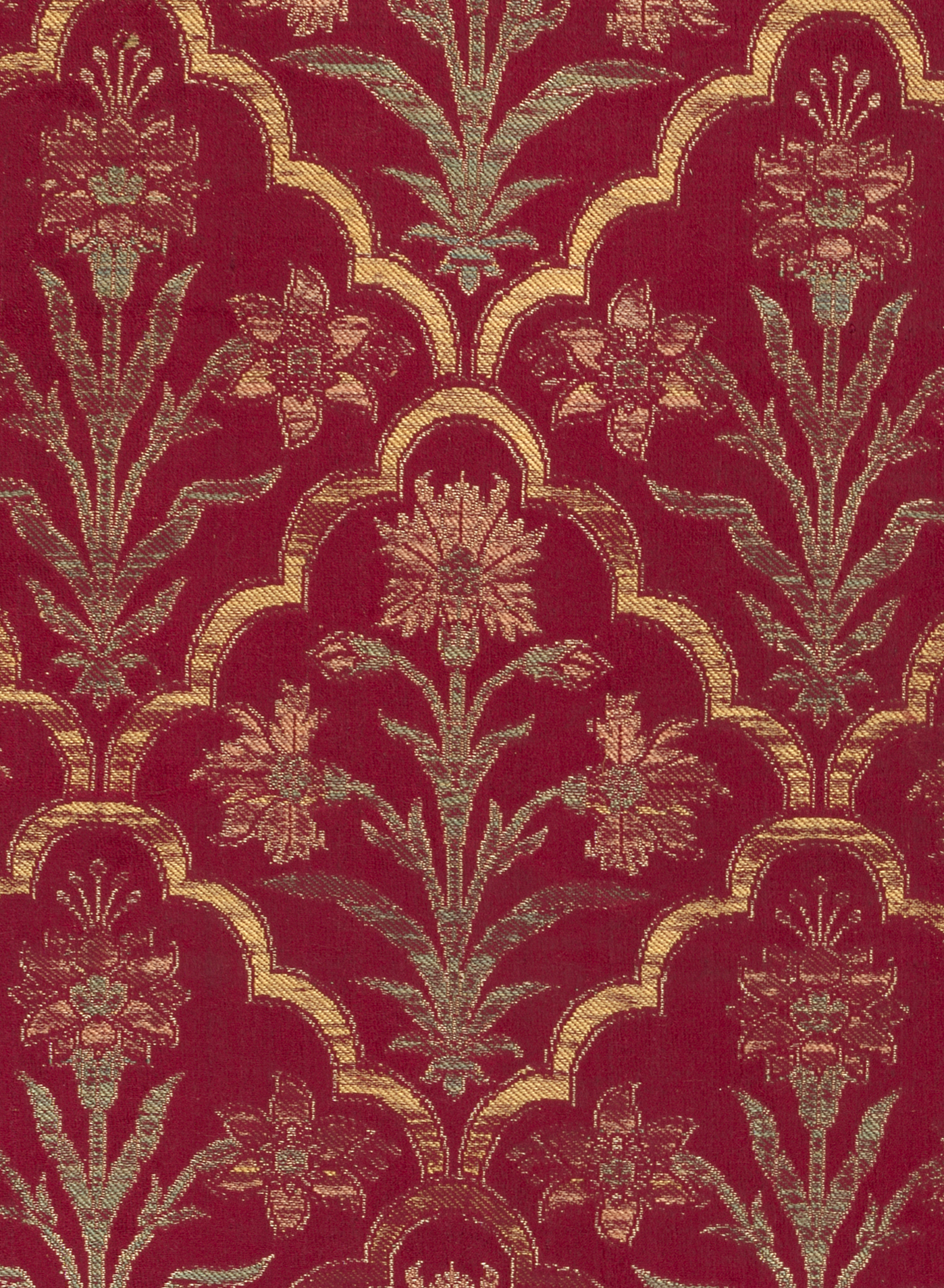
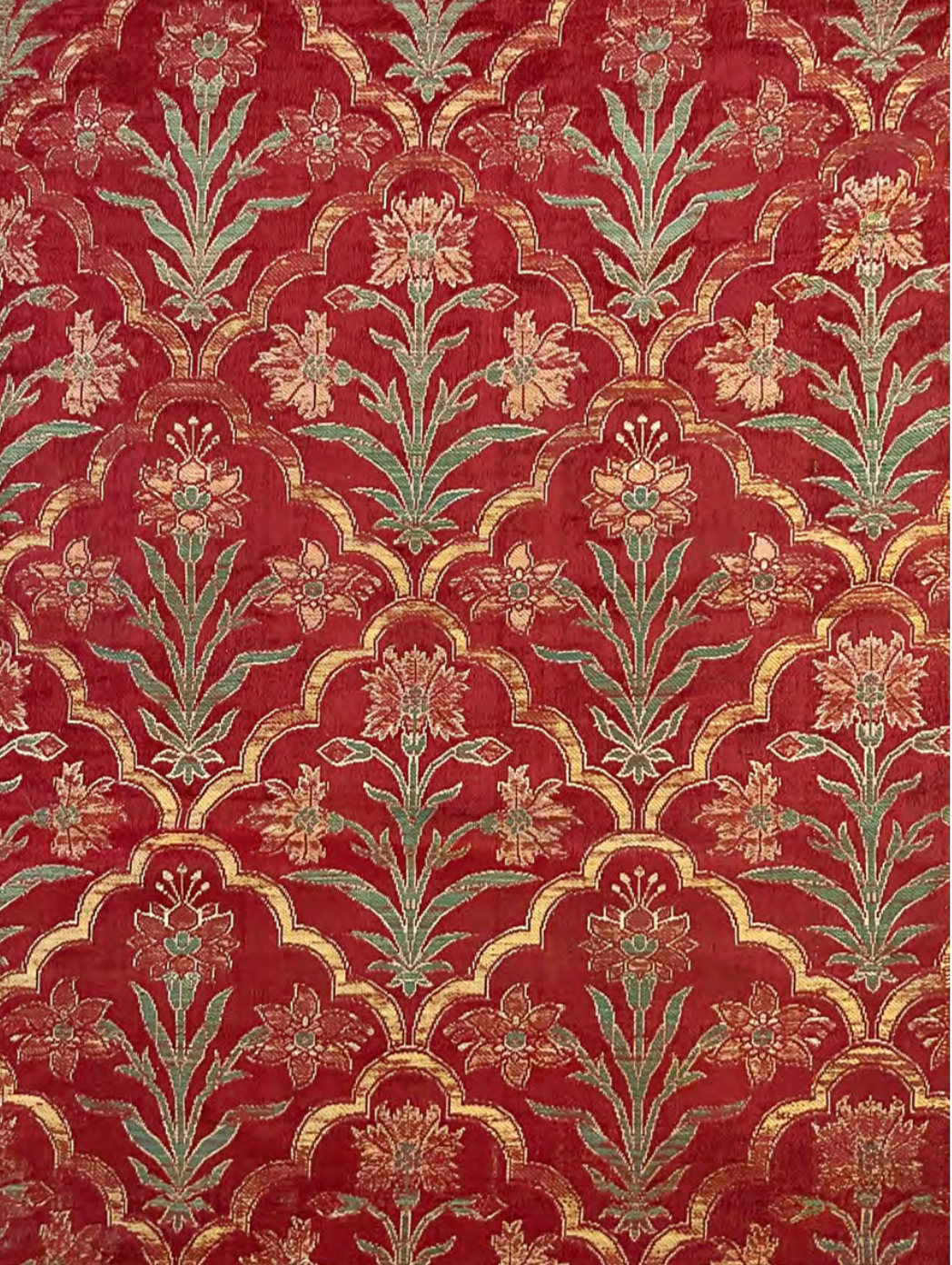
A lampas-weave silk with a red, 4/1 satin foundation patterned with continuous supplementary wefts, in white, green, yellow and pink, all bound in a 1⁄2 twill with a purplish pink supplementary warp; full loom-width of approx. 38 inches; originally lined with a coarse, plain- weave cotton with black and brown warp stripes, and edged with a narrow, chevron-patterned braid of silk and metal thread.
Introduction
It is extremely rare, today, to come across unknown Mughal textiles making an appearance in the public domain. To come across a textile that is clearly connected to imperial Mughal production, and that belongs to a trophy genre as yet unknown from any other courtly Indian source, is perhaps the rarest of all such instances. This length of woven silk is a direct descendent of a well-known suite of silk tentage woven at an imperial workshop for the emperors Shah Jahan and Aurangzeb, in the middle decades of the 17th century. So far as we know, this textile is the last surviving product of that Mughal silk-weaving tradition. Quite apart from its sheer rarity, this textile is also remarkable for its sensational colour and beautiful design.
This silk was woven on a drawloom in a complex lampas technique, which had been used exclusively for luxury silks across the Asiatic, North African and European empires since the early second millenium. The silk is patterned with a formal floral lattice of a style that first appeared in Mughal India in the mid-17th century, and variants of which remained popular for their decorative appeal right up to the modern period. In this textile, two flowering plant motifs, each under a simple cusped arch, alternate in rows. The plants are woven in four colours of silk against a striking jewel-red ground. The flower-and-arch motifs are offset and repeated across the fabric to create a densely- patterned, fish-scale lattice.
Originally, two long lengths of this silk were stitched together to form a double-width furnishing panel. But the fabric lengths were not stitched together with the woven motifs facing the same direction, as we would expect. Instead, the direction of the motifs in the two lengths was opposite to each other. This suggests that the original double-width panel was not used as a hanging/curtain, which would presumably have had all its flowering plants oriented in the same direction. If the panel was intended for use as a horizontally-laid furnishing, it may have served as a decorative but secondary floor or dais cover, given the absence of any formal decorative borders. More generally, the directional lattice of this silk would have been best-suited for vertical use as a palace or tent hanging/curtain, or for cutting and assembling into a tent ceiling/canopy such that the flowering plant motifs were seen upright all the way to the top. In all likelihood, the silk arrived into a royal textile store as bolts of fabric, which were only later cut up and stitched into furnishings as needed.
The furnishings woven for Shah Jahan and Aurangzeb comprised at least one pair of private tents, assembled from panels of one of the heaviest and most monumental qualities of silk lampas known from any medieval imperial source in Asia or Europe. The sheer weight of the rich, satiny fabric creates, in the manner of rare Safavid silk carpets, an impression of surpassing luxury. The formal, architectural-scale floral patterns mirror the surface decoration of mid-17th century Mughal buildings, as well as that of trophy objects produced in the court workshops at the time, for the imperial family and their favoured associates. (FOOTNOTE 1: See Rahul Jain, Textiles and Garments at the Jaipur Court, Niyogi Books, New Delhi, 2011, no. 16, pp. 80-83) The woven motifs include stately flowering plants under cusped and fringed arches, grand floral arabesques, as well as elegant foliate medallions and cartouches, all woven in three or four stock colours of silk against the same jewel-red ground. (Figures 3 and 4) Unquestionably, those silk lampas panels would have created a tented retreat of great beauty and sensuousness, which reflected perfectly the Mughal emperors’ remarkable wealth and aesthetic sensibilities.
Portable cloth architecture of this type was the most spectacular of all paraphernalia of royal life and material culture in Mughal India. Large tented encampments accompanied the emperors, princes and generals on wars, pilgrimages, hunts and pleasure retreats. At the heart of what were sometimes city-sized camps lay intimate and highly ornamental palaces of cloth. These afforded the imperial household and its entourage the shelter, comfort and beauty to which they were accustomed. Luxurious pashmina carpets, brightly-coloured cotton chintzes, and precious gold embroideries and silk brocades, all lent to the inner circle of private tents the splendour of the imperial Mughal residences in Agra, Lahore and Delhi. Official chronicles, travelers’ accounts, court paintings, as well as the surviving remnants of royal tents, all testify to this magnificence.
The surviving portions of the silk lampas tentage woven for Shah Jahan and Aurangzeb include a number of wall panels (qanat), a pair of large canopies or floorcovers, a marquee roof, and a few other fragmentary panels. These are now distributed between the Calico Museum of Textiles, Ahmedabad; the Bharat Kala Bhavan, Varanasi; the Salar Jung Museum, Hyderabad; the Lahore Museum; the Musee des Arts Asiatiques- Guimet, Paris; the Museum fur Indische Kunst, Berlin; the Nasser Khalili Collection of Islamic Art, Geneva/London; and the Metropolitan Museum of Art, New York. Some panels of this tentage can now be traced back, via inventory inscriptions on their fabric, to the royal tent stores of the Rajput kingdom of Amber, whose Rajas were the Mughal emperors’ leading military commanders. The inscriptions suggest that the imperial tentage may have been received as a military accoutrement or an honorific gift from the Mughal court, or was purchased by the Rajas of Amber via privileged access to an imperial workshop. Possibly, the surviving portions belong to two or more tent ensembles, which may have been woven in the imperial workshops over a few decades. The Amber inventory years inscribed on some of the panels include 1647, 1668 and 1679. (FOOTNOTE 2: See Rahul Jain, ibid.). While court inventory inscriptions have not been found on our silk, it was also in the possession of a former Rajput state since the 19th century.
Accession No
Date
Dimensions
Attribution

