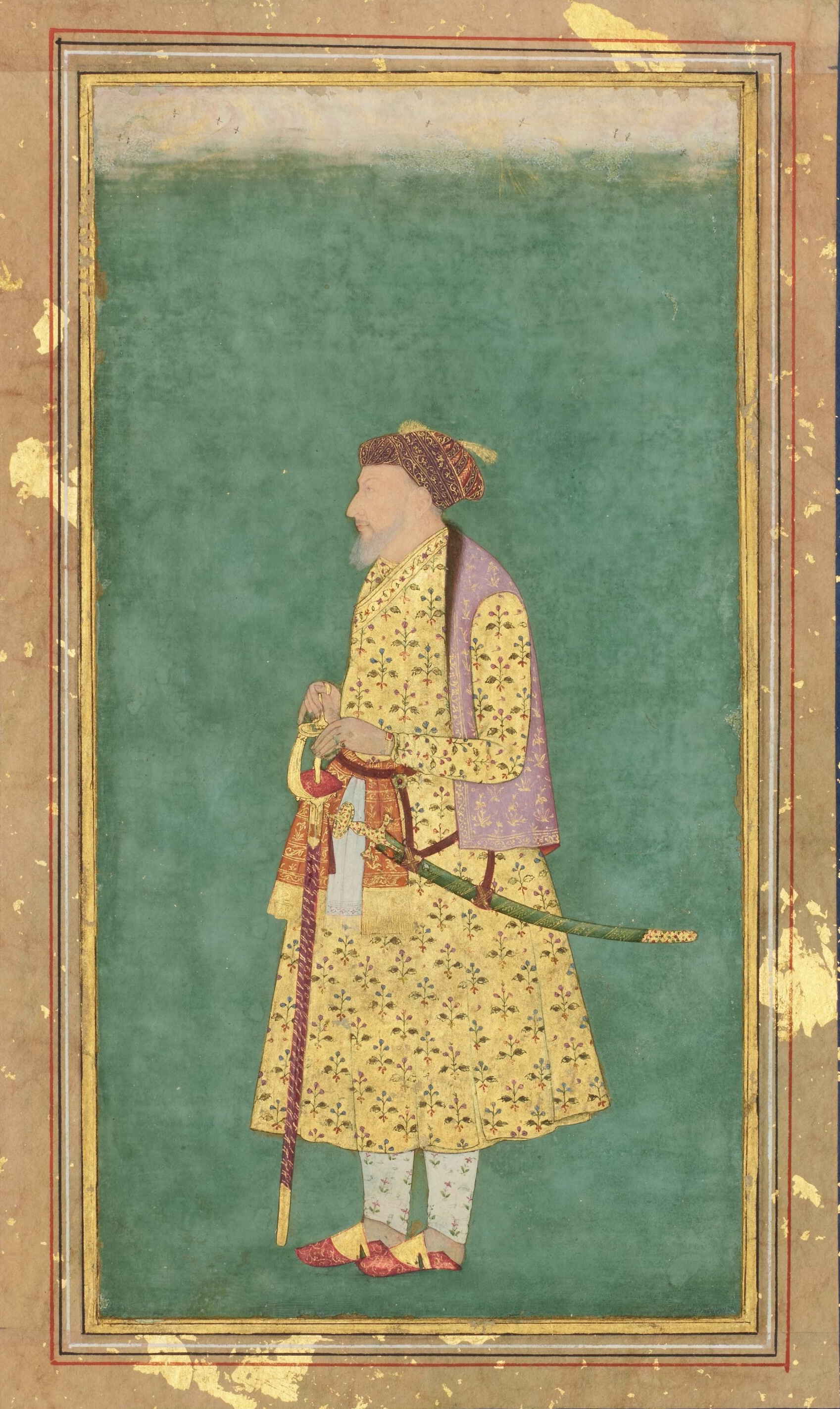
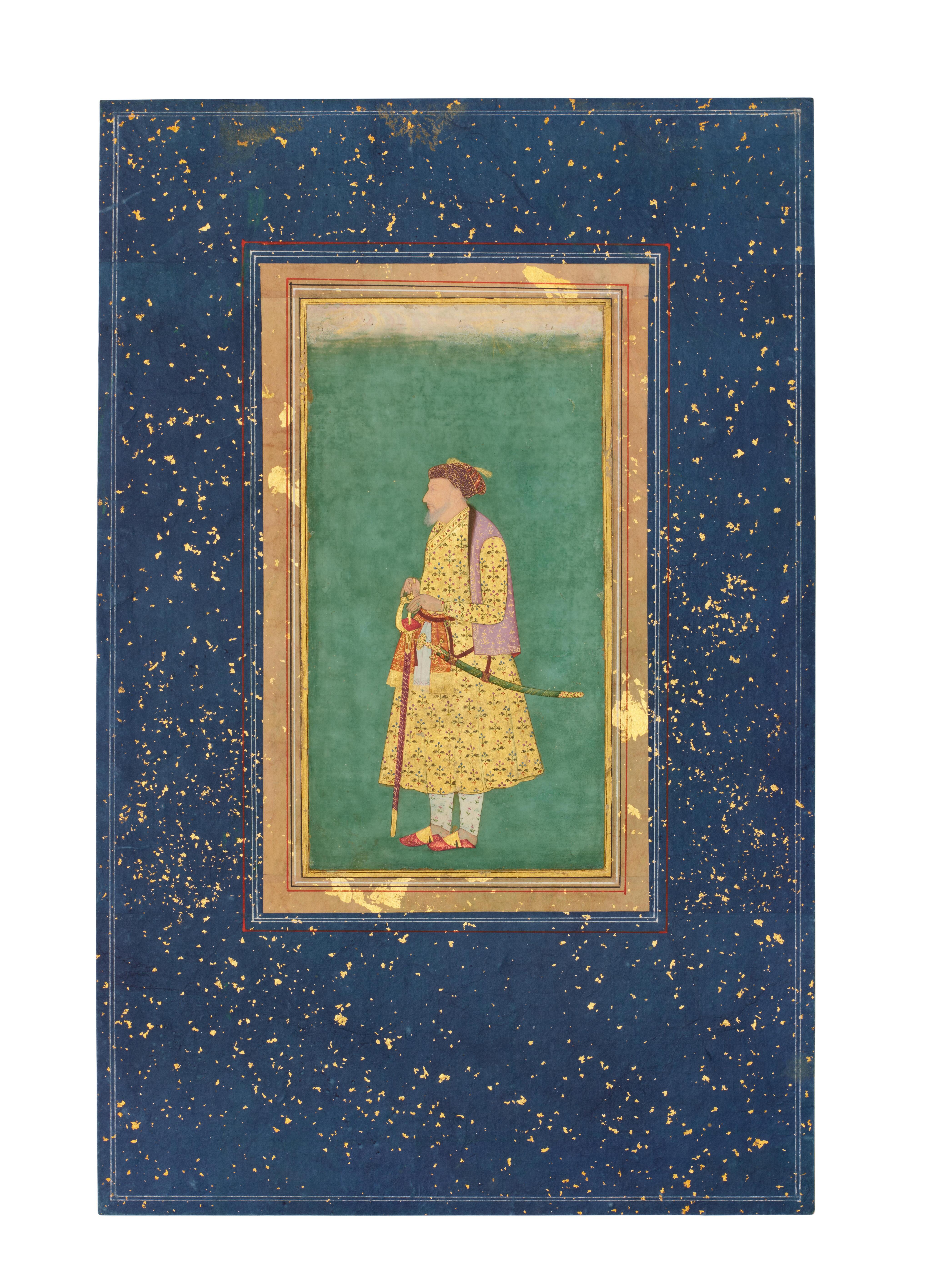
Afzal Khan ‘Allami was born and educated in Shiraz, arriving in the Mughal court via Surat and Burhanpur where he served with Abd al-Rahim Khankhanan. By 1615 he was employed within the royal entourage of Prince Khurram, the future Shah Jahan, who gave him the title of Afzal Khan. On Shah Jahan’s accession in 1628, Afzal Khan was made a mansab of 4,000, then Mir Saman and then Diwan-I A’la, Prime Minister. Emperor Shah Jahan is said to have held Afzal Khan in high regard, awarding him a mansab of 7,000, the highest known rank and apparently visiting Afzal Khan on his deathbed in January 1639.
Afzal Khan appears in sixteen of the forty-four illustrations in Shah Jahan's Padshanama. Each time he is depicted with his distinctive large hooked nose and thin grey beard. The detail in the present portrait is worthy of note, particularly in the rendering of his wrinkles, sagging around his eyes and his furrowed brow all indicative of his age. He is shown wearing a luxurious fur-lined violet vest and sumptuous gold jama, with exquisite patterning echoed on his patka, sword hilts and archer’s ring. The emphasis the artist has placed on the jama brings us to ask whether this could be a representation of the robe of honour that Afzal Khan was given by the Emperor in 1637. This portrait is closely comparable to a depiction of Afzal Khan in the Padshahnama, dated 1635 and ascribed to Balchand, (Beach et al. 1997, pl.5.). Seyller compares the two portraits and notes the faintness of the line particularly around the face in the present painting which is atypical of Balchand's style and concludes that maybe this portrait is unfinished. (Seitz & Seyller 2010, p.60).
Literature
J. Seyller and K. Seitz, Eva and Konrad Seitz Collection of Indian miniatures, Mughal & Deccani paintings, Zurich, 2010, p.59, no.13
Exhibited
Dazzling Visions, Mughal and Deccani Paintings from the Collection of Konrad and Eva Seitz, Museum Rietberg, Zurich, 30 November 2010 - 10 April 2011
Accession No
Provenance
Artist
Dimensions
Date
Medium