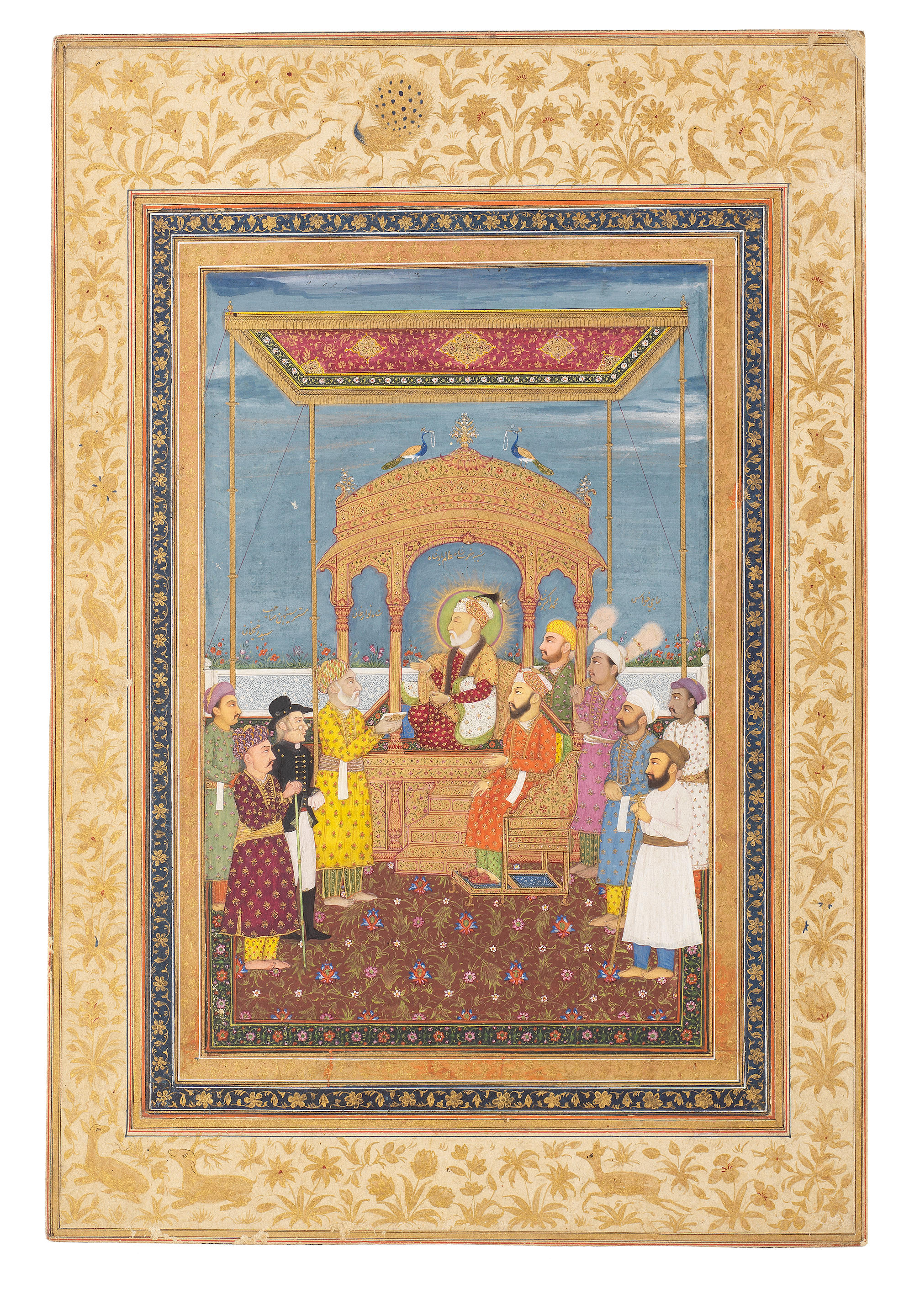
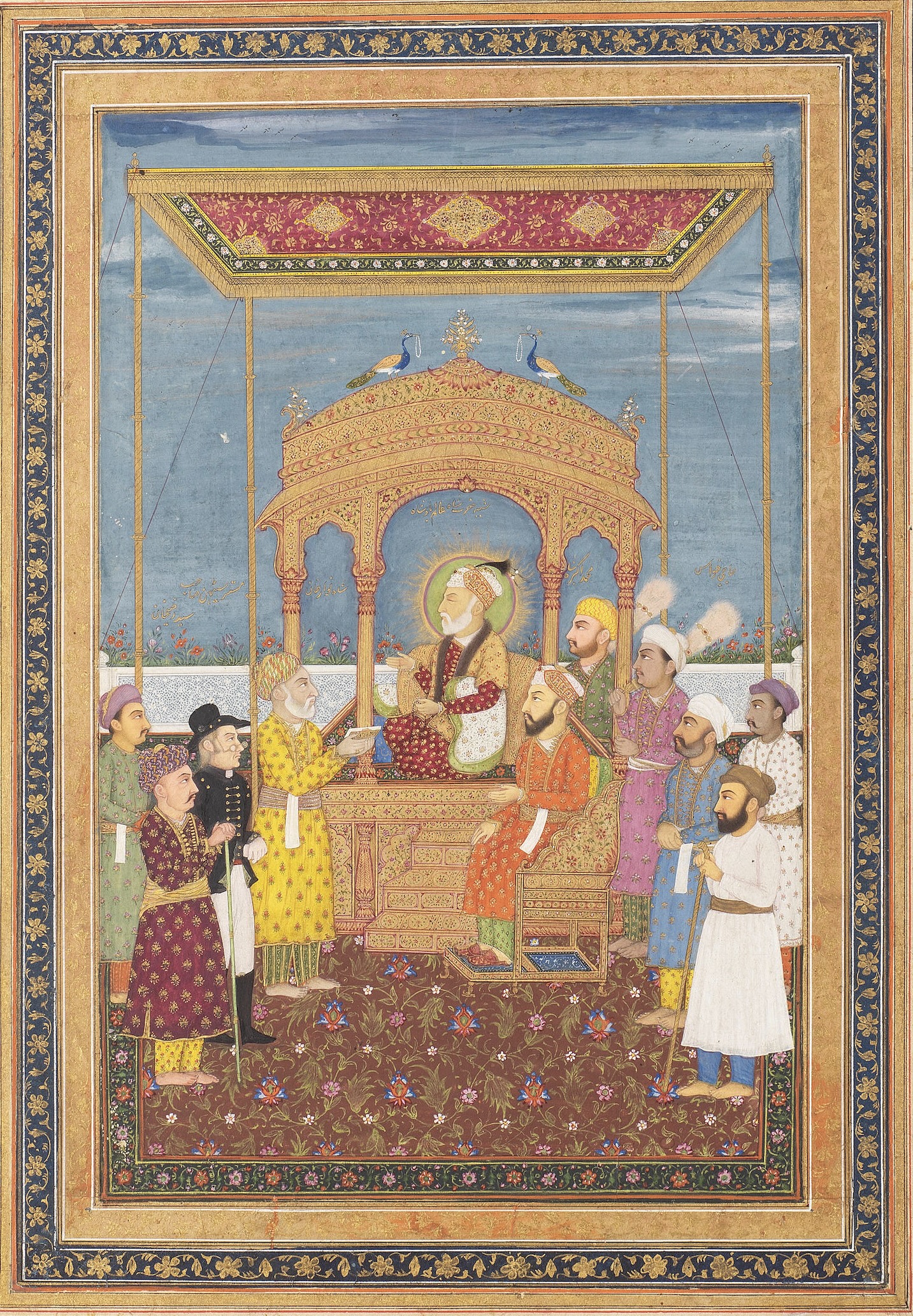
Our painting takes its place as one of the finest examples of late Mughal durbar scenes. The Blind Emperor, Shah Alam II, seems emblematic of the catalogue of gradual but often shocking disasters which overtook the Mughal Empire in the 18th Century. The very throne he sits on here, and in other paintings, was a late 18th Century reconstruction of the famous Peacock Throne, which had been taken to Persia by Nadir Shah after his catastrophic invasion of 1739, which took place when the future emperor was ten years old. Against a background of British encroachment and tribal threats, Shah Alam was blinded at the age of sixty (a ghastly fate which he lamented in a Persian poem) in an act of brutality by the Afghan chieftain Ghulam Qadir, after he had sacked the Mughal treasury in 1788.
Archibald Seton (1758-1818) was Resident at Delhi from 1806 to 1811, succeeding David Ochterlony. He started in a junior position at Madras in 1781 and twenty-five years later, having served in increasingly senior posts, was named Resident at the Mughal court at Delhi in the waning days of the reign of Shah Alam II, who died in November 1806, succeeded by Akbar Shah II. Little is recorded of the relations between Seton and Akbar Shah, but it is well known that the Crown Prince, Mirza Jahangir, bristled against the Resident's presence, and shot at Seton one day in 1811. Seton survived, though he was quickly removed from the court and moved sideways (perhaps) to an appointment as Governor of Penang, where he served for about a year before returning to India to take up a seat in the Supreme Council of Bengal. He died in 1818 during his journey home to England.
INSCRIPTIONS:
The various figures and their identifying inscriptions are as follows:
Above the Emperor, in the centre:
'The image of His Majesty Shah 'Alam Padshah'.
On the right:
'Muhammad Akbar Shah', his son, the future Emperor Akbar II (reg. 1806-37).
Further to the right:
'Jaji [Haji] Khwas [Khas]'.
Haji Khas is portrayed as an old man amongst a large number of courtiers in a painting of Akbar II in durbar with the British resident Charles Metcalfe, in the Cincinnati Art Museum, attributed to Ghulam Murtaza Khan, circa 1811-15 (illustrated and discussed in W. Dalrymple, Y. Sharma (edd.), Princes and Painters in Mughal Delhi 1707-1857, New York 2012, pp. 108-109, no. 32).
On the left of the Emperor, in yellow:
'Shah Nawaz Khan'.
This is most probably Samsam al-Dawlah Shah Nawaz Khan (d. 1758) a historian and minister of Asaf Jah's, who together with 'Abd al-Hayy wrote al-ma'athir wa al-athar, a biography of men who flourished in India from Akbar's time. Here, he is depicted possibly presenting Shah 'Alam with a volume of his book (though presumably, given the date of his death, there is a certain amount of licence being taken by the artist).
'Mr Seton Sahib'
Archibald Seton (d. 1818), the British Resident, 1806-11.
'Sayyid Razi Khan'.
Possibly the father of Muhammad Qasim (a Nawwab of Bengal and a supporter of the East India Company). If so it is therefore appropriate that he stands next to Seton.
Accession No
Provenance
Dimensions
Date
Medium
-1777377436.jpg)